
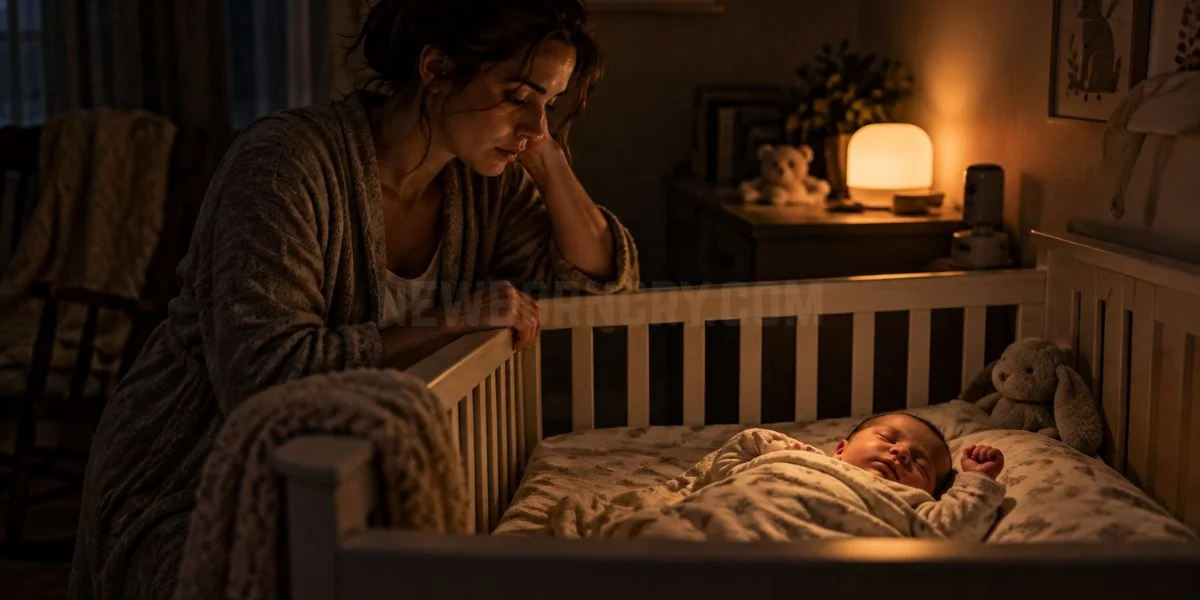
It’s 2 AM. Your baby is asleep — but they’re whimpering, twitching, and making little crying sounds. You’re frozen. Do you pick them up? Leave them? Is something wrong?
You hover over the crib. One hand is already reaching.
This is the question that wrecks first-time nights: why is my baby crying in sleep, and does this cry need you?
Most of the time, those sounds mean your baby is still asleep. Newborn crying in sleep is common. That does not mean you ignore every cry. It means you learn the difference.
Table of Contents
Why Is My Baby Crying in Sleep? Active Sleep, Explained Simply
Newborns do not sleep the way you sleep.
Adults fall into still, deep sleep first. Babies often start in active sleep — their version of REM. In the early months they spend about half of all sleep time there.
Active sleep is light. The brain is busy. Unlike an adult in REM, a baby’s body is not locked down. So they twitch, grunt, smile, suck, and let out a little cry — eyes still closed.
Cycles run about 40 to 60 minutes. Each shift can bring a few seconds of noise. Then, if nobody scoops them up, many babies drop back down.
That brief sound is not always a request. Sometimes the brain is just changing gears.
What Active Sleep Actually Looks Like
If you have been staring at the monitor, this may finally name your nights.
Normal active sleep signs include:
- Twitching in the hands, feet, or face
- Grunting, squeaking, or a short cry that fades
- A smile that appears and vanishes
- Sucking motions with no milk in sight
- Fluttering eyelids and irregular breathing that settles
- A startle, then stillness again
Eyes can crack open for a second. If they flutter shut and the body stays loose, your baby is usually still asleep.
Quiet sleep looks different — breathing evens out, the face goes still. That “finally sleeping” look comes and goes all night.
What’s Actually Happening in Their Brain
This is why twitching can look like distress and still be healthy work.
Your baby’s nervous system is still wiring itself. Those little jerks during active sleep may help the brain map the body — how an arm moves, how a hand closes, how a face works. The twitches are practice. The smiles may not be happy dreams. They can be the face rehearsing expressions.
All day your baby takes in light, milk, voices, and touch. Active sleep is one of the times the brain files some of that away.
The startle reflex (Moro) can add a sudden flail and a cry. It fades over the first months. Until then, a safe swaddle can soften those mid-sleep jumps.
So the 2 AM whimper is often not pain. It is a busy brain doing night work.
Baby Crying in Sleep: Should I Pick Them Up?
Your instinct says go. That instinct kept humans alive. It is also how a 12-second fuss becomes a 40-minute wake.
Do not always pick up a baby who cries in sleep. If they are still asleep, lifting them can finish the wake-up their brain was about to skip.
The “Wait 30 Seconds” Rule
When you hear a cry, stop. Count to thirty. Watch the monitor or stand in the doorway without speaking.
Are the eyes mostly closed? Is the cry rising — or sputtering and fading? Does the body look tense and searching, or twitchy and half-loose?
If the sound peaks and drops — stay put. Plenty of babies cry out between cycles and resettle on their own.
Go in if the cry turns rhythmic and insistent, keeps building, or you know it is feed time, a soaked diaper, or a night that already feels off.
Waiting 30 seconds is not “cry it out.” It is a pause so you can tell sleep noise from a real wake.
Sleep Crying vs Real Waking
Sleep crying is short, uneven, and mixed with twitches or sucking. The baby may settle if you do nothing.
Real waking has a direction. The cry organizes. Eyes stay open. Once that cry is in gear, pick them up.
When they are awake and you cannot tell hunger from discomfort, our newborn cry decoder can help you sort the sound without guessing in the dark.
Growth Spurts, Gas, and the Overtired Loop
Not every whimper is just active sleep. Some nights are harder.
Growth spurts make sleep noisier. Appetite jumps. Baby cries in sleep more because they are hungrier between cycles. Cluster feeding for a night or two is often the fix.
Gas and discomfort sound different from a dreamy whimper. Knees pull up. The belly feels tight. The grimace does not pass. Burp well before the last feed. If every stretch ends in pain cries, call your pediatrician.
Overtiredness is the sneaky one. A baby who stayed up too long often drops into jumpy, noisy sleep — more twitching, more crying out.
If late-day fussing is your pattern, try our baby wake window calculator and protect the last nap. An earlier bedtime can quiet the night more than another lap around the house.
According to the AAP infant sleep guidelines — back to sleep, firm flat surface, no loose blankets, and room-sharing without bed-sharing for at least the first six months. Comfort your baby, then put them back on their back.
Do Babies Have Nightmares?
This question hits around month four, when the cries sound sharper.
True nightmares need imagination and memory. A three-week-old is not dreaming about monsters.
Nightmares can appear as early as 6 months in some children and become much more common in the toddler years. What looks like a “bad dream” in a young baby is usually a cycle stir, gas, or a startle.
If an older infant wakes suddenly and needs you, comfort them. For a newborn, assume active sleep first.
What Actually Helps
- Keep the room dark when they fuss — light tells the brain it is showtime
- Use a short wind-down — same order, same low voice every night
- Swaddle newborns who are not rolling yet if it calms the startle
- Watch daytime timing — an overtired baby cries more in sleep
- Check the basics first — last feed, diaper, room temperature, stuffy nose
- If you are shaking from exhaustion — set the baby down safely and step out for two minutes
Normal vs Concerning — A Quick Check
Use this in the hallway at 2 AM.
| . | Usually Normal | Worth a Closer Look |
|---|---|---|
| Sound | Short whimper or cry that fades | Cry that builds or will not console |
| Body | Twitches, smiles, sucking, loose limbs | Rigid body or jerking after they wake |
| Eyes | Closed or briefly fluttering | Staring or odd movements while awake |
| Breathing | Irregular for a bit, then settles | Ribs pulling in, long pauses, color change |
| Timing | Cycle changes, growth spurts | Sudden change plus fever or poor feeding |
| After you wait | Often resettles in under a minute | Keeps escalating or still looks like pain |
Normal: twitching, grunting, a fading cry, a random grin, then back to sleep.
Concerning: labored breathing, color change, a new high-pitched cry, jerking that continues after they wake, or a baby you cannot rouse.
Trust the table. Trust your gut if the two disagree.

When to Call Your Pediatrician
Call the same day — or go in now — if sleep crying comes with any of these:
- Fever in a baby under 3 months (100.4°F / 38°C or higher)
- Breathing that looks like work, long pauses, or color that turns blue or gray
- A cry that is weak, high-pitched, and new for your baby
- Poor feeding, fewer wet diapers, or a baby who is hard to wake
- Jerking that continues after they wake
- Your instinct that this is not their usual nighttime noise
You will not sound dramatic. A short video of the movements often helps more than a description.
You Are Not Failing at 2 AM
You are allowed to pause. You are allowed to go in. You are allowed to change your mind halfway through the count.
Baby crying in sleep is usually the sound of a growing brain — not a baby in trouble. Learn your child’s pattern. Use the 30-second wait. Keep sleep safe. Call when something feels off.
Those nighttime noises get quieter as sleep matures. Until then, you are doing exactly what you should be doing — showing up. 💛
Frequently Asked Questions
Why is my baby crying in their sleep?
Usually active sleep or a short cycle change. Hunger, gas, a growth spurt, or overtiredness can add real distress on top of that noise.
Should I pick up my baby when they cry in sleep?
Not every time. Wait about 30 seconds. If eyes stay closed and the sound fades, leave them. If the cry organizes and builds — pick them up.
Is it normal for babies to cry in their sleep?
Yes. Twitching, whimpering, and short cries during active sleep are completely typical in the first months.
Why does my newborn cry in sleep?
Newborns spend about half their sleep in a noisy REM-like state, their cycles are short, and the startle reflex is still strong.
Do babies have nightmares?
True nightmares are unlikely in newborns. They become more common in toddlers. Early on, treat sleep crying as active sleep or a physical need unless your pediatrician says otherwise.
Written by S.A., founder of NewbornCry.com. Learn more about me here.
Medical Disclaimer: This article is for educational purposes only and is not a substitute for professional medical advice. Always consult your pediatrician with any concerns about your baby’s sleep or health.