
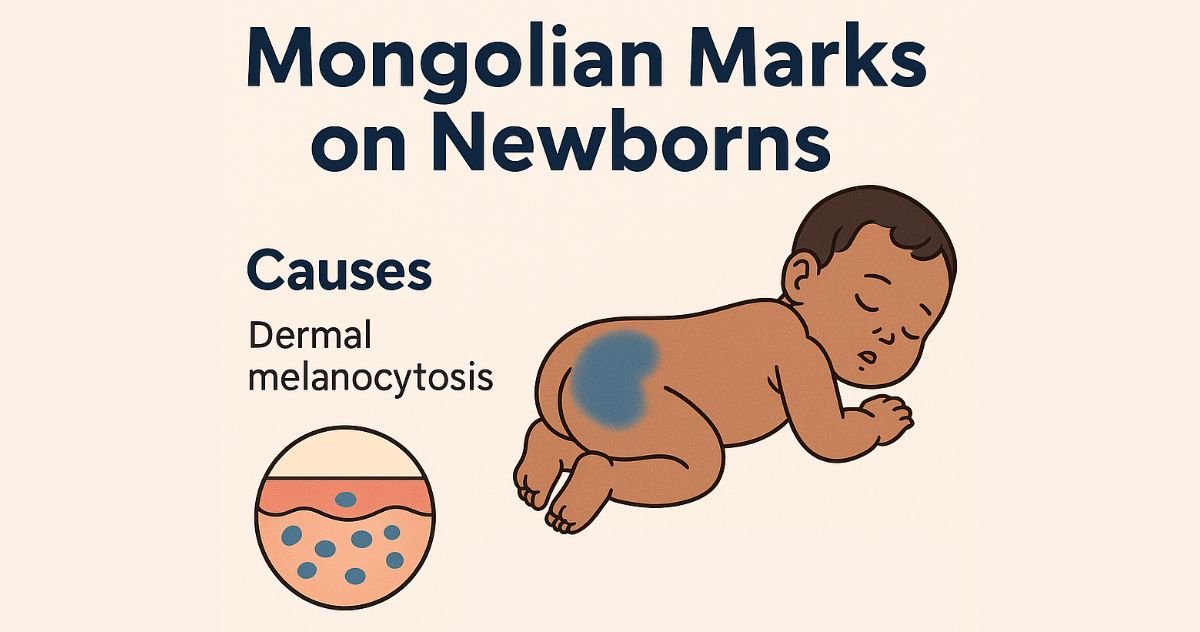
There’s no need to freak out if you’ve noticed bluish-gray marks on your newborn’s skin. Millions of babies worldwide have these unique birthmarks, called Mongolian spots, which are entirely benign. It’s normal for parents to be concerned about any mark on their baby’s sensitive skin. From what causes mongolian marks on newborns to when (and if) you should be concerned, this thorough guide will help you understand it all.
What Are Mongolian Marks on Newborns?
Mongolian spots, medically known as congenital dermal melanocytosis or slate gray nevi, are a type of birthmark that appears on many newborns .
These marks are flat, benign skin discolorations that often appear at birth or develop during the first few weeks of life .
Appearance and Characteristics
Color: Mongolian spots typically display a distinctive blue-gray appearance, though they can range from:
Shape and Texture: These birthmarks have several identifying features:
- Flat to the touch (not raised)
- Wavy, irregular borders
- Varying sizes, from small patches to larger areas spanning several centimeters
- Uniform color throughout the affected area
Common Locations: While mongolian blue spot baby marks can appear anywhere on the body, they’re most frequently found on:
The spots often have a round or irregular shape and can easily be mistaken for bruises due to their blue-gray coloring .
What Causes Mongolian Marks?
Understanding mongolian spot causes helps parents feel more confident that these marks are a natural occurrence, not a sign of injury or illness.

The Scientific Explanation
During fetal development, melanocytes—the cells that give skin its color—become trapped in the dermis, the deeper layer of skin, causing Mongolian spots. Melanocytes typically move to the epidermis, the skin’s outermost layer, prior to birth. Nonetheless, some of these pigment-producing cells stay in the dermis in infants with Mongolian spots, giving the skin’s surface its distinctive blue-gray look. Similar to how veins appear blue through the skin even though blood is red, the bluish color results from the fact that we are viewing these melanocytes through layers of skin tissue.
Why Some Babies Develop Them
The exact reason why melanocytes don’t complete their migration in some babies remains unclear, but researchers believe it’s related to:
- Genetic factors
- Ethnic background
- Normal variations in fetal development
Important note: Mongolian spots are not caused by:
- Anything the mother did or didn’t do during pregnancy
- Birth trauma or injury
- Vitamin deficiencies
- Medical complications
Who Gets Them Most Often?
Mongolian spots show a strong correlation with ethnic background, appearing much more frequently in certain populations.
Prevalence by Ethnicity
Research shows that mongolian marks on newborns are significantly more common in babies of:
- Asian descent: Up to 80-90% of newborns
- African American descent: Approximately 90-96% of newborns
- Hispanic/Latino descent: Around 70-80% of newborns
- Native American descent: Very high prevalence, similar to Asian populations
- Caucasian descent: Only 5-10% of newborns
Statistics Relevant to the USA
In the diverse American population, Mongolian spots are extremely common. Given that the United States has large Asian American, African American, Hispanic, and Native American communities, millions of babies are born with these birthmarks each year. For many multicultural families, seeing these marks is a completely normal part of their newborn’s appearance.
Are Mongolian Marks Dangerous?
This is often the first question worried parents ask, and the answer is reassuring.
Medical Safety
Mongolian spots are completely harmless and benign.
They:
- Do not cause pain or discomfort
- Don’t itch or irritate the skin
- Pose no health risks
- Don’t increase cancer risk
- Require no medical treatment
Reassurance for Parents
If you’re asking “are mongolian spots harmful,” you can rest easy. These birthmarks are simply a cosmetic variation in skin pigmentation. Your baby cannot feel them, and they won’t affect their development, health, or well-being in any way.
Important Distinction: These Are NOT Bruises
One of the most critical things parents need to know is that Mongolian spots are not bruises. Unfortunately, because of their blue-gray color and common location on the lower back and buttocks, they’ve sometimes been mistaken for signs of abuse by well-meaning but uninformed individuals.Key differences between Mongolian spots and bruises:
| Mongolian Spots | Bruises |
|---|---|
| Present at birth or appear in first weeks | Appear after injury |
| Don’t change color quickly | Change color as they heal (purple→green→yellow) |
| Borders remain consistent | Borders may be more defined |
| Don’t cause pain | Usually tender to touch |
| Fade slowly over months/years | Heal within 1-2 weeks |
If your baby has Mongolian spots documented in their medical records, it can prevent any confusion during routine checkups or emergency visits.
Helpful Tool for Parents – Easily Merge Your Baby’s Medical PDFs: As you collect your baby’s medical documentation, including photos and records of their Mongolian spots, you might need to organize multiple PDF files. Tools like PDF merging services can help you keep all your baby’s health records in one convenient file for easy sharing with healthcare providers.
Do Mongolian Marks Go Away?
Most parents wonder about the long-term outlook for these distinctive birthmarks.
Typical Fading Timeline
The good news is that most Mongolian spots fade significantly or disappear completely as children grow. Here’s what to expect:By age 1-2 years: Many spots begin to lighten noticeablyBy age 3-5 years: The majority of Mongolian spots have faded substantially or disappeared entirely
By puberty: Most remaining spots have resolved
When They May Persist Longer
While most mongolian blue spot baby marks fade during early childhood, some factors may influence how long they last:
- Larger spots may take longer to fade completely
- Darker or more extensive marks might persist into adolescence or adulthood
- Spots located on areas other than the lower back (such as shoulders or legs) may fade more slowly
- Multiple spots may have varying timelines for fading
Even when Mongolian spots persist into adulthood, they typically become much lighter and less noticeable over time.
Mongolian Spot Myths vs Facts
Cultural beliefs and misconceptions about these birthmarks abound. Let’s separate fact from fiction.
Common Cultural Myths
Myth #1: Mongolian spots are caused by a deity or spirit touching the baby before birth
Fact: These marks result from melanocytes remaining in the dermal layer of skin—a completely natural biological process
Myth #2: The spots indicate the baby was slapped or struck during delivery
Fact: Mongolian spots form during fetal development, long before birth, and are not related to birth trauma
.Myth #3: Eating certain foods during pregnancy causes these marks
Fact: Maternal diet has no connection to mongolian spot causes. They’re determined by genetics and normal developmental variation.
Myth #4: The spots mean the baby will have special powers or abilities
Fact: While this is a charming cultural belief in some traditions, Mongolian spots are simply benign birthmarks with no connection to a child’s abilities or destiny.
Myth #5: You can prevent or remove them with home remedies
Fact: No creams, oils, or home treatments affect Mongolian spots. They fade naturally on their own timeline.
Scientifically Correct Facts
✓ Mongolian spots are a normal variation in skin pigmentation ✓ They’re more common in babies with higher melanin levels ✓ They’re completely harmless and painless ✓ They typically fade without any intervention ✓ They’re one of the most common birthmarks worldwide
When Should Parents See a Doctor?
While Mongolian spots themselves are harmless, there are certain situations where medical evaluation is appropriate.
Red Flags to Watch For
Consult your pediatrician if:
- The mark appears to be changing rapidly in size, color, or texture
- The spot is raised or bumpy rather than flat (true Mongolian spots are always flat)
- The area becomes painful, warm, or inflamed
- The mark bleeds or develops sores
- New spots appear suddenly after the first few months of life
- The spots are accompanied by other unusual symptoms such as developmental delays or neurological issues
Signs the Mark May Not Be a True Mongolian Spot
Sometimes what appears to be a Mongolian spot could be a different type of birthmark or skin condition:Café-au-lait spots: Light brown marks that could indicate neurofibromatosis if numerous Hemangiomas: Raised, red birthmarks caused by blood vessels Nevus of Ota: A similar pigmentation that affects the face and eye area Port-wine stains: Flat, pink to purple marks that don’t fadeIf you’re uncertain about any mark on your baby’s skin, it’s always better to have it evaluated by a healthcare professional. A simple examination can provide peace of mind.
Documentation Matters
At your baby’s first pediatric visits, make sure the doctor documents any Mongolian spots in the medical record. This documentation:
- Provides a baseline for monitoring
- Prevents confusion with bruising
- Helps other healthcare providers understand your child’s normal appearance
Real-Life Parent Examples
Maria’s Story: “When my daughter Sofia was born, I saw big blue-gray spots on her buttocks and lower back.” I was scared something was wrong because it was my first time being a mom. Right away, the pediatrician reassured me that they were Mongolian spots, which are common in Hispanic babies like Sofia. You can hardly see them now that they are 4 years old. I wish I didn’t have to worry so much!” “Our son Kai was born with large Mongolian spots covering his back, shoulders, and legs,
” James and Keiko wrote. Since Keiko’s family is Japanese, they knew them right away and told us they were fine. Our child’s doctor confirmed this and took pictures to keep for himself. Kai is now seven years old. There are still a few faint marks on his skin, but they aren’t noticeable and have never caused him any trouble. Tasha’s View: “As an African American mom, I’d seen my nieces and nephews with Mongolian spots, so it didn’t surprise me when my twins did too.” The difference in how they faded surprised me. My daughter’s was gone by age 3, but my son still has a faint spot at age 6. Each kid is unique!”
Frequently Asked Questions
Do Mongolian spots hurt?
No, Mongolian spots are completely painless. Babies cannot feel them at all. They’re simply areas of pigmentation in the skin with no nerve involvement or sensitivity. If your baby seems uncomfortable in an area with a Mongolian spot, the discomfort is unrelated to the birthmark itself.
Are they related to vaccines?
Absolutely not. This is a common misconception. Mongolian spots are present at birth or appear in the first few weeks of life, which happens to coincide with early vaccination schedules. However, vaccines do not cause, worsen, or have any connection to mongolian marks on newborns. The timing is purely coincidental.
Can they be prevented?
No, there’s no way to prevent Mongolian spots. They form during fetal development based on genetic factors and normal variations in how melanocytes migrate in the skin. Nothing a parent does or doesn’t do during pregnancy affects whether a baby will have these birthmarks.
Will they come back later?
Once a Mongolian spot fades, it will not return. The melanocytes that caused the pigmentation gradually disperse or are absorbed by the body. Unlike some skin conditions that can recur, Mongolian spots follow a one-way path toward fading and don’t reappear once they’ve resolved.
Do mongolian spots go away completely?
Most do, but not all. The majority of Mongolian spots fade significantly or disappear entirely by early childhood.
However, some may persist into adolescence or adulthood, though they typically become much lighter and less noticeable over time. Even persistent spots remain harmless.
Conclusion
Mongolian marks on newborns are actually pretty common and totally harmless birthmarks that nature gives us. So, you know those unique blue-gray spots? They’re actually caused by melanocytes getting stuck in the dermal layer of the skin. It’s pretty common and happens to millions of babies every year, especially among those of Asian, African, Hispanic, and Native American backgrounds.
Key takeaways for parents:
- Mongolian spots are completely safe and require no treatment
- They are NOT bruises and don’t indicate any health problems
- Most fade significantly or disappear by early childhood
- They’re a normal variation in skin pigmentation, not a medical concern
- Documentation in medical records helps prevent confusion
If you are worried about marks on your baby’s skin, don’t wait to see your pediatrician. Mongolian spots are harmless, but getting them checked out by a professional can give you peace of mind and make sure you get the right diagnosis. Remember that these pretty birthmarks are just part of your baby’s unique look. They are a short-term reminder of their early days that will probably go away as they grow, leaving only precious newborn photos.
Also read this interesting blog: How Many Bones Are Babies Born With? Complete Guide for New Parents