
Introduction
The newborn’s chest circumference is one of the most important measurements that doctors take immediately after birth to determine how the baby is growing and how healthy they are overall. This measurement, known as “newborn chest size,” assists parents and doctors in tracking a baby’s growth during the critical first few days. Most people understand how to measure a baby’s weight and length, but they frequently fail to measure the baby’s chest circumference.
It can also be useful for detecting early signs of health problems. Knowing the “newborn chest circumference” allows parents to compare growth charts, consult with pediatricians, and ensure a healthy start for their baby. This article will provide American parents with all of the necessary information about the normal range, how to measure it, how it varies, and specific World Health Organization (WHO) recommendations.
Before we go deep, take a quick check: use our free Baby Growth Tracker Tool to compare your baby’s height, weight, and chest circumference with WHO standards. Get instant results, simple measuring tips, and a clear weekly progress view.
What is the circumference of a newborn’s chest?

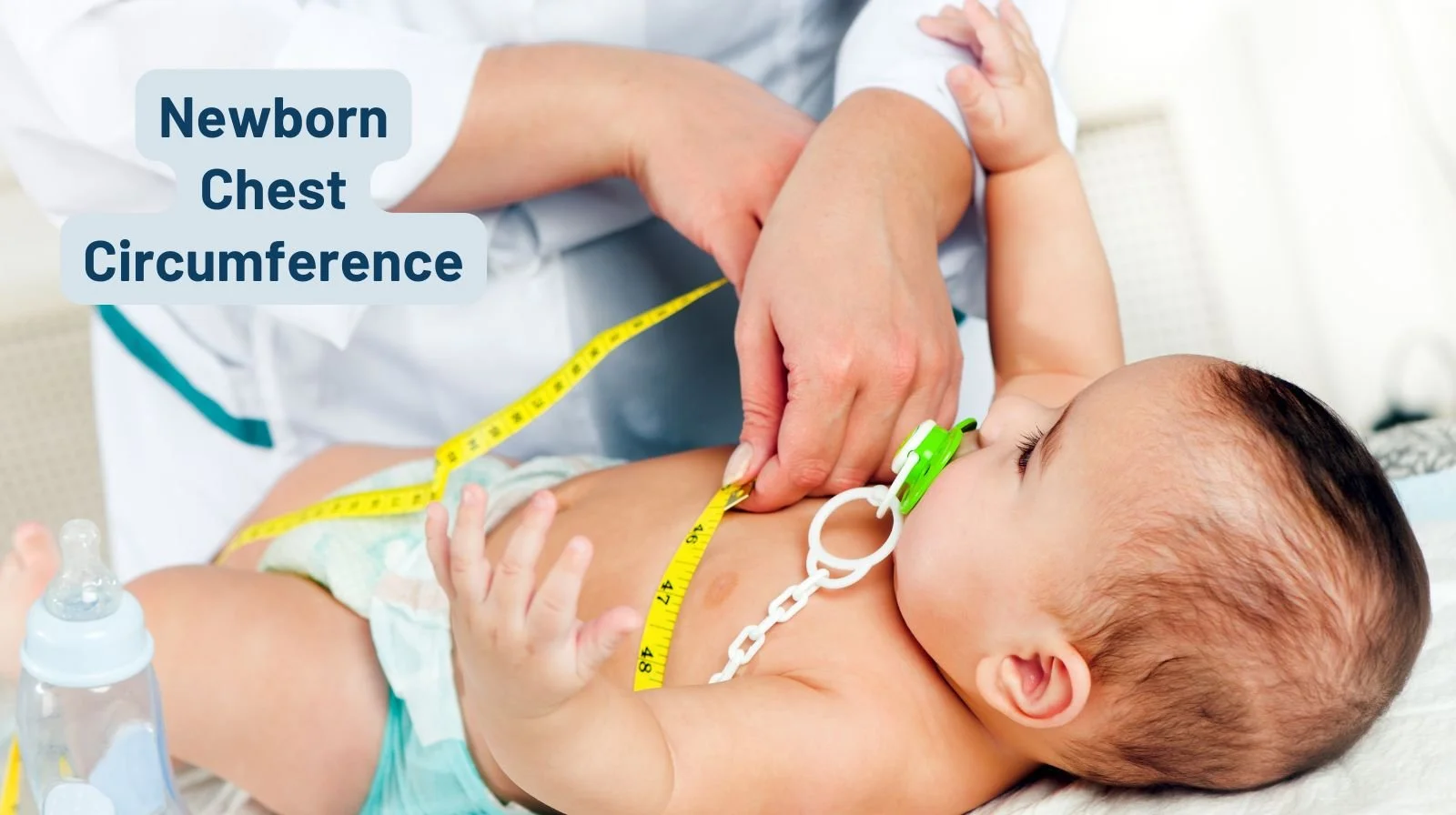
The newborn chest circumference measures the distance around your baby’s widest part of the chest. It is typically measured at birth, alongside other newborn chest measurements such as length, weight, and head circumference. This “newborn baby chest circumference” usually remains constant for the first few days of life, indicating some expected growth patterns.
What do doctors look for when examining a newborn’s chest? The baby’s heart and lungs are located in the chest cavity. They grow as the baby eats during pregnancy and after birth. Doctors can quickly determine whether a newborn’s chest size is appropriate for the rest of their body by measuring its circumference.
Doctors may be asked to perform additional tests if the measurement results differ significantly from what was expected. Changes, even minor ones, from the norm may indicate potential problems as you mature. Even though it is simple to take a chest measurement, we should not underestimate its importance. Monitoring the baby’s chest size over time allows parents and pediatricians to monitor the baby’s breathing, identify any birth defects early, and ensure the baby’s overall development remains on track.
A newborn’s normal chest size
People frequently ask, “What is the normal chest circumference for a newborn?” The World Health Organization (WHO) and many pediatric guidelines state that a newborn’s chest circumference should be between 31 cm and 33 cm at birth. While the “newborn chest circumference normal value” is typically within this range, there are individual variations.
It’s important to note that a newborn’s chest circumference can vary slightly depending on factors such as genetics, prenatal nutrition, and whether the baby was born full-term (37-42 weeks). This is a normal range for babies, though some may be slightly lower or higher. This variability demonstrates that babies develop in various ways.
Typically, pediatricians say that a baby’s chest circumference at birth is “normal” if it is between 31 and 33 cm.
Why 31 to 33 centimeters?
- According to the WHO’s growth charts for newborns, most healthy newborns have a chest measurement that falls within this range.
- Proportional Growth: At birth, babies’ heads are larger than their chests and torsos. If a newborn’s measurement differs significantly from 31-33 cm, doctors usually check to ensure that everything is functioning properly and growing as expected.
Remember that the average, or typical, range is exactly that: an average. Some babies are slightly taller or shorter than average and have no problems. Your pediatrician will evaluate your baby’s overall health to determine whether the difference is significant or a normal variation.
Head circumference vs. chest circumference in newborns.

Another common question concerns the size of the baby’s head and chest. Typically, both are measured when the baby is born. On purpose, the head circumference is typically greater than the chest circumference. When a baby is born, the chest circumference is typically 2 cm smaller than the head circumference. This difference becomes smaller as the baby grows.
Parents should remember that measuring a newborn’s chest and head are two different ways to assess their growth. If the baby’s chest is normal but the head is too big or too small, doctors can investigate possible causes such as hydrocephalus or other conditions that cause the head to grow excessively large or small. When the two measurements are identical, healthcare professionals can be confident that the baby is developing normally.
How to Measure a Newborn’s Chest Circumference: Steps
In the hospital, nurses or doctors typically measure a baby’s chest, but parents may need or want to do so at home on occasion. Learning how to measure a newborn’s chest circumference can help you keep track of your baby’s growth in the weeks following birth. This is an easy way to do it.
1. Learn the Basics.
You’ll need a soft, flexible measuring tape similar to the ones tailors use. This tape is ideal for smoothing out the curve of a baby’s chest.
2. Set the Baby Down.
Place your baby on a flat, safe surface. Check that they are relaxed and lying on their backs. You may want to remove some of your baby’s clothing to get the most accurate measurement.
3. Determine the point of measurement.
To measure the baby’s chest circumference, wrap the tape around his or her chest at the nipples or just below the armpits. This is the area of the chest that most people believe is the widest.
4. Put on the tape.
Ensure that the tape wraps around the baby’s back and meets at the chest. It should fit snugly, but not too tight or twisted.
5. Write down the size.
When you see it lined up, write down the measurement in centimeters. This step concludes the process of measuring a newborn’s chest circumference. It may be easier to track your progress if you write down the date and time.
6. Repeat (optional).
You can measure it again to ensure it stays the same. You could also make a quick drawing of your newborn’s chest and record the numbers in your baby scrapbook.
Check with your child’s doctor to determine how frequently you should measure your baby’s chest at home. It is usually not necessary to do it as frequently as a weight check. However, being able to take measurements with confidence is always beneficial.
Changes in the chest circumference of newborns.

Given that newborns come in a variety of shapes and sizes, it’s natural to wonder about potential differences from the “standard.” Let us look at the variations in newborn chest circumference measurements, expressed in centimeters, that can occur under various conditions.
Preterm versus Full-Term
A preterm newborn’s chest circumference is typically smaller than that of a full-term baby. Babies born before 37 weeks may have a chest circumference that is significantly smaller than 31 cm. However, neonatal care providers will closely monitor them with growth charts designed specifically for premature babies.
Large Chest Size
Many factors can contribute to a newborn’s large chest circumference, including genetics and maternal conditions such as gestational diabetes. Healthcare workers will closely monitor these babies to ensure that their chests are in line with the rest of their bodies.
Little Girls
A newborn baby girl’s chest circumference is usually slightly smaller than a baby boy’s. However, the difference is usually small, perhaps only a centimeter or two.
No matter how big or small your baby’s chest is, what matters most is that it grows steadily and proportionally over time. During a pediatric check-up, doctors frequently examine growth percentiles and other indicators such as head circumference and weight.
Reference Values and Charts
There are also charts for babies’ chest circumferences, weights, and lengths. The phrase “infant chest size chart” refers to average measurements for babies of specific ages. Here’s an example of a baby chest circumference chart to give you some ideas:
Age (in weeks) Expected chest circumference (cm) Birth: 31-33 cm 4 weeks (32-34 cm) Weeks: 32-348 weeks, 33-35 cm 12 Weeks: 34-37 cm
Of course, each baby is unique, and some doctors use more detailed percentile charts to make accurate comparisons. Some parents are looking for a “baby chest size chart knitting” to make sweaters, onesies, and vests that fit their baby’s measured circumference. When knitting a baby chest size, it is important to consider how it will fit. A snug fit is necessary to ensure that your baby can breathe and move freely.
WHO’s rules for newborns
According to WHO guidelines, newborns’ chest circumferences should be between 31 and 33 cm at birth. These internationally recognized standards also emphasize the importance of comprehensive medical examinations. This is why the WHO’s newborn guidelines consider not only chest circumference but also weight, length, and head size. A single number may be normal, but doctors and nurses require a wide range of information to get a complete picture of a baby’s health.
According to the World Health Organization, you should take measurements frequently during the first few months of life to detect problems early. They also emphasize the importance of educating parents, agreeing that grandparents who know what they’re doing can collaborate with healthcare providers to ensure that interventions are implemented when necessary.
Useful for parents.
New parents may struggle to understand the term “newborn chest circumference” at first. But don’t worry, it’s a simple measurement that rarely requires any special tools or knowledge other than a flexible measuring tape. The best part is that you can see how your baby is developing.
During routine visits, pediatricians usually measure babies’ chest circumference. However, you can measure it at home if you notice any changes or simply want to know. Furthermore, parents who enjoy crafting may find the measurement useful for “baby chest size knitting.” This method ensures that the baby’s clothes fit just right: snug enough to be comfortable but not too tight around that delicate, growing area.
If the knitted item feels too tight, please remeasure and make any necessary adjustments. Newborns grow quickly, so what fits one week may not fit the next. Finally, for parents who enjoy photographing their baby each month to show how much they’ve grown, drawing or charting the baby’s chest circumference in a scrapbook can be a fun way to remember it. It is not required, but it is a great way to see how quickly your child is developing.
Questions & Answers
1. What is the average measurement of a newborn’s chest?
A newborn’s “normal chest circumference” is usually 31 to 33 cm. Most pediatricians agree with the WHO’s range. Some newborns, however, may measure slightly larger or smaller without incident. Genetics, the baby’s overall health, and whether the baby is full-term or preterm all have the potential to influence the first measurement. Always check with your pediatrician to ensure that your baby’s chest size is increasing at the same rate as other growth indicators such as weight and head circumference.
2. What size is a newborn’s body?
A baby’s “body circumference” refers to the size of its head or chest. A newborn’s head and chest circumferences are typically 33–35 cm and 31–33 cm, respectively. With these measurements, doctors can get a better sense of how the baby is developing as a whole and identify any problems early on. If you notice that your baby’s measurements are significantly different from these averages, consult your doctor to ensure that there are no underlying issues or to confirm that the deviation is normal.
3. What is a normal chest size?
Most babies have a chest circumference of 31 to 33 centimeters. This measurement is usually consistent with the head circumference, which is typically about 2 cm larger. Some newborns may not fall within this range for a variety of reasons, including birth weight, genetic background, or health issues. A single static number is less important than consistent, proportional growth. If you take your child to the doctor on a regular basis, they will ensure that their measurements are consistent with their overall growth patterns.
4. What characterizes a newborn as normal?
Normal infants have stable vital signs, a healthy weight (typically 2.5-4.0 kg at birth), a strong cry, and body measurements within normal limits. These include a newborn’s typical head circumference of 33 to 35 cm and chest circumference of 31 to 33 cm. Some signs that your baby is doing well include good eating habits, quick reflexes, and regular breathing. Always see a doctor to get a complete picture of your baby’s health based on several factors.
5. How do you take a baby’s chest measurement?
It is not difficult to measure your baby’s chest. Begin by positioning your baby on their back on a flat surface. Wrap a soft measuring tape around the baby’s chest, just below the armpits or at the nipple line, without applying too much pressure. The goal is to achieve a snug fit that is not too tight. When reading the measurement in centimeters, make sure the tape touches in one place so you can see the precise number. This method is similar to how hospital nurses and pediatricians measure babies’ chest circumferences.
6. What are the WHO’s guidelines for newborns?
The World Health Organization (WHO) emphasizes the importance of closely monitoring newborn health. According to WHO neonatal guidelines, doctors and other healthcare professionals should regularly check a newborn’s weight, head circumference, and chest circumference to ensure that all measurements are within normal ranges. These suggestions provide a consistent method for detecting breathing problems, birth defects, or insufficient weight gain early on. Monitoring development trends is critical in neonatal care because it allows doctors to address any issues that may arise.
7. Can parents track their child’s chest size at home?
Of course. Parents can easily track their child’s development by measuring their baby’s chest circumference at home. Some people choose to do this for their own peace of mind or to provide doctors with additional information if needed, but it is not required. If the measurements appear unusual, or if you notice a significant increase in size, you should consult a doctor. If you’re knitting something for your child, measuring at home can help ensure that the “baby chest size knitting” fits perfectly and feels comfortable.
In conclusion.
Measuring the circumference of a newborn’s chest is more than just a hospital procedure; it reveals a lot about your baby’s growth in the first few weeks. Keeping track of your baby’s weight, chest size, length, and head circumference will help you understand how they are developing. The “newborn chest circumference” is usually between 31 and 33 cm at birth, but keep in mind that some healthy babies may fall slightly outside of that range.
Instead of taking a single picture, these measurements over time are the most effective way to assess how well your newborn is doing. Parents should monitor their child’s growth at home and take them to the doctor frequently, especially during the first few months.
Chest measurements are a simple but effective way to monitor your health and ensure that your knitted clothing fits properly. If you want to track your baby’s growth, use our Smart Baby Growth Tracker. It could be a valuable tool for parents, providing regular updates on their child’s growth and development.
Sources
This article’s information is based on established growth standards and pediatric guidelines from leading global health organizations, ensuring accuracy and reliability.
- The World Health Organization (WHO) states that the normal size of a newborn’s chest is between 31 and 33 cm, based on data from a study of healthy, breastfed babies in optimal conditions.
- The American Academy of Pediatrics (AAP) recommends routine newborn assessments, including chest circumference measurement during pediatric check-ups, as well as guidance on monitoring infant growth and development, which are consistent with the AAP’s policies and guidelines.
Parents are always encouraged to discuss any questions or concerns about their child’s development with their pediatrician.